Android Sensor Telemetry System
The Android Telemetry System is a client-server application developed to collect, transmit, and monitor real-time telemetry data from an Android device. The project extends a custom application-layer protocol and demonstrates how telemetry information generated by a device can be gathered, serialized, transmitted over a network, and displayed on a monitoring dashboard.
The Android device acts as a telemetry client while a central server receives, processes, and displays incoming data. The project was developed using Python, TCP sockets, and Termux on Android.
Motivation
After developing a custom application-layer protocol, I wanted to apply it to a practical problem rather than limiting it to simple message exchange between clients and a server.
Modern devices continuously generate useful information such as battery statistics, CPU usage, memory consumption, storage metrics, network information, and location data. The goal of this project was to understand how telemetry systems operate by building one from scratch using a custom protocol and a client-server architecture.
Technical Concepts Explored
- Client-Server Architecture
- Telemetry Systems
- Application-Layer Protocol Design
- TCP Socket Programming
- Event-Driven Networking
- Data Serialization
- Real-Time Data Transmission
- Mobile System Monitoring
- Android Sensor Access through Termux
- Network Communication
Architecture
The system follows a client-server architecture where the Android device acts as the telemetry client. The client collects system and sensor information and packages it into protocol-defined messages.
These messages are transmitted to a central server using TCP sockets. The server receives telemetry packets, processes incoming information, updates internal state, and presents the data through a command-line monitoring dashboard.
┌─────────────────┐
│ Android Device  │
│   (Termux)      │
└────────┬────────┘
         │
         │ Custom Protocol
         │
         ▼
┌─────────────────┐
│ Telemetry Server│
└────────┬────────┘
         │
         ▼
┌─────────────────┐
│ CLI Dashboard   │
└─────────────────┘
Telemetry Data Collected
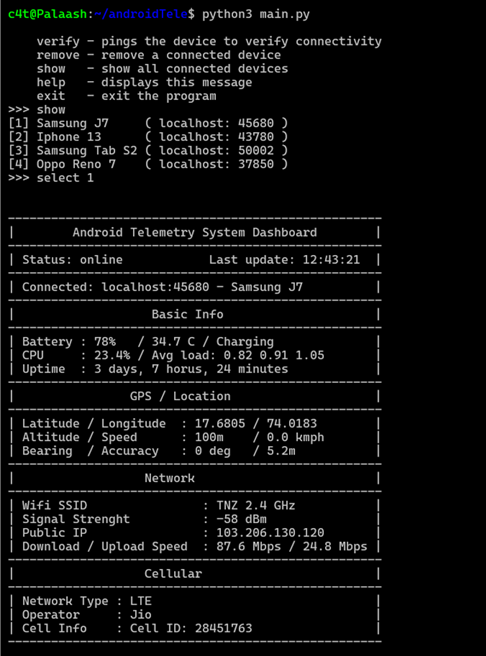
The system collects and transmits a wide range of telemetry information from the Android device, including battery statistics, CPU usage, memory utilization, storage information, network status, location information, and internet connectivity metrics.
- Battery Percentage, Temperature and Charging Status
- CPU Usage and Load Average
- RAM Usage Statistics
- Storage Utilization
- System Uptime
- GPS Coordinates and Location Data
- Wi-Fi Information and Signal Strength
- Cellular Network Information
- Internet Connectivity Statistics
Protocol Integration
The telemetry system was built as an extension of a previously developed custom application-layer protocol. Instead of creating a separate communication mechanism, telemetry information is transmitted using the existing protocol structure.
This provided practical experience in extending protocol functionality, designing telemetry-specific payloads, and adapting communication systems to support real-world applications.
Dashboard Implementation
The server provides a command-line monitoring dashboard that displays incoming telemetry information in an organized format. The dashboard updates dynamically as new data is received from the Android device.
Challenges Encountered
Collecting telemetry information from Android devices required understanding how Termux interacts with Android system APIs and available command-line interfaces. Additionally, telemetry data contains multiple data types, making reliable serialization and deserialization an important challenge.
The project also required extending the existing protocol architecture while maintaining compatibility and designing efficient methods for transmitting real-time telemetry information without excessive network overhead.
Key Learnings
- Telemetry System Design
- Mobile Device Monitoring
- Distributed Systems
- Protocol Extension and Adaptation
- Real-Time Data Transmission
- Client-Server Communication
- Event-Driven Networking
The project demonstrated how communication protocols can be extended to support practical monitoring systems and provided hands-on experience with telemetry collection, network transmission, and real-time visualization of remote device data.
Future Improvements
- Historical Telemetry Logging
- Graphical Dashboard Interface
- Multi-Device Monitoring
- Encrypted Communication
- Alerting and Notification Systems
- Telemetry Analytics and Visualization
Conclusion
The Android Telemetry System successfully demonstrates the collection, transmission, and visualization of device telemetry using a custom application-layer protocol. The project combines networking, protocol design, system monitoring, and real-time communication concepts into a practical application while providing hands-on experience with telemetry systems and distributed software architecture.